
Jefferson County Court Records After a Jail Arrest
In Jefferson County, the court record for a criminal case opens after the arrest, not at the moment of arrest. The Jefferson County Clerk explains the chain clearly. After a felony arrest and booking, the jail sends the initial paperwork and any release form to the clerk's felony department. The clerk prepares the official court file, which includes the original arrest document, and forwards it to the Office of the State Attorney. The State Attorney reviews the case and decides whether to file formal charges. Those filed charges are the court record people search for after an arrest.
The booking side and the court side answer different questions. For who is in custody and the booking detail, the jail inmate records page covers the roster and the sheriff's channels, and the jail roster mugshots page covers booking photos. The court record itself shows the charges the prosecutor filed and how the case moves through the court. A booking charge can change a lot before it becomes a formal court charge.
How to Find Jefferson County Court Records After an Arrest
Court charges and case status in Jefferson County are searched through the clerk's Online Court Records Search, known as OCRS and run on the CiviTek platform. The clerk's felony FAQ links the public court search and says limited information is also available by phone. To view a full file, the felony department sits in Suite 203 at the Jefferson County Courthouse, 1 Courthouse Circle, Monticello, FL 32344, open 8:00 a.m. to 5:00 p.m. Monday through Friday, with a phone line at 850-342-0218 extension 233.
- Open the Jefferson County OCRS portal and choose the Public access option.
- Search by the defendant's name or the case number.
- Open the case and read the list of charges the prosecutor filed.
- Check each charge's status, since charges can be amended, reduced, added, or dropped.
The OCRS access screen below shows the four entry choices: Public, Attorney, Registered User, and Party Access.
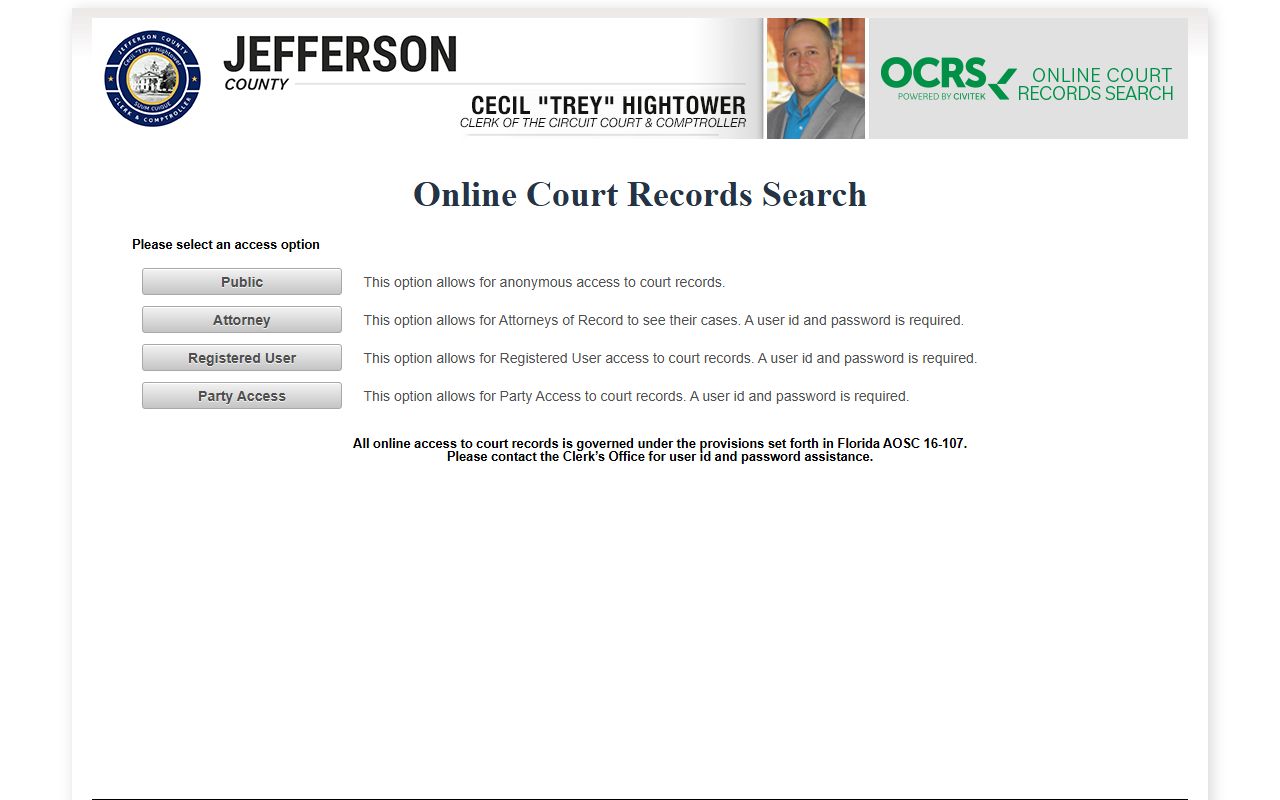
Public access is open to anyone, while attorney, registered, and party access need a login under Florida administrative order AOSC 16-107.
| Access Option | Login | Notes |
|---|---|---|
| Public | None | Anonymous access to court records. |
| Attorney | Required | Attorneys of record; user ID and password needed. |
| Registered User | Required | Registered user access; user ID and password needed. |
| Party Access | Required | Party to the case; user ID and password needed. |
For older, sealed, or restricted matters, or when the portal does not show a file, the clerk's formal records request fills the gap.
How Charges Get Filed After an Arrest: Complaint, Information, and Indictment
The court record begins when a charging document is filed. Booking happens first at the jail, and then a prosecutor or a grand jury formally states the charges. Florida uses three main charging documents, and which one applies depends on the level of the offense. The clerk's felony page describes the State Attorney's review as the step that decides what gets filed.
| Complaint | Information | Indictment | |
|---|---|---|---|
| Filed By | Officer / Prosecutor | State Attorney | Grand Jury |
| Common For | Misdemeanors | Many felonies | Serious felonies |
| Starts | The case | The case | The case |
The clerk's felony page below explains the jail-to-clerk-to-State-Attorney workflow and the arraignment notice.
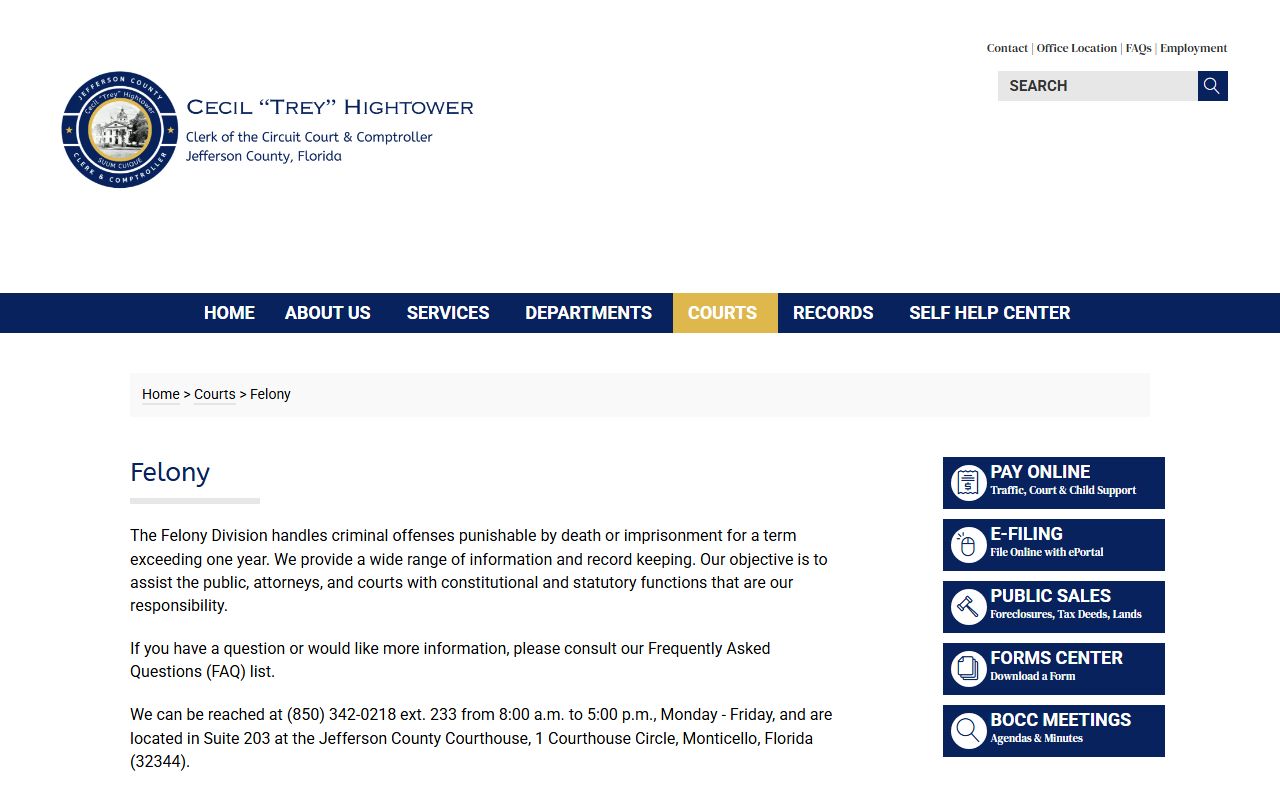
It is the clearest local source for how a Jefferson County arrest turns into a filed court charge.
Charge Status After an Arrest and What It Means
Charges shift as a case moves. The prosecutor can amend a charge, reduce it, add a new one, or drop it. The charge recorded at booking is only a starting point and can differ from what the State Attorney finally files. A court docket can also show filings and events even after the jail roster no longer lists the person. The terms below show up often in a Jefferson County case file.
| Status | What It Means |
|---|---|
| Pending | The charge is filed and the case is still open and moving through court. |
| Amended / Reduced | The prosecutor changed the charge, often to a lesser offense. |
| Dismissed | The charge was dropped and is no longer being pursued. |
| Nolle Prosequi | The prosecutor formally declined to pursue the charge. |
Bond and Release After an Arrest
Bond is usually addressed at the first appearance soon after a booking. The clerk's felony page gives strong local detail on cash bond. After a case is resolved, a cash bond may be released to the depositor only, and under Florida Statute 903.286 the court can direct part of it toward fines, court costs, or restitution. If a refund is due, the depositor gets a Cash Bond Release Notice from the felony department and delivers it to the sheriff's office. A refund is not automatic at the jail counter.
| Bond Type | How It Works |
|---|---|
| Cash Bond | The depositor pays cash; a refund after the case may go to the depositor only, minus court-directed costs. |
| Surety Bond | A bail bond company posts the bond; the clerk notifies the bondsman when the person bonds out. |
| Release at First Appearance | A judge may release the defendant, who then gets the court date notice at that time. |
| No-Bond Hold | Release on bond is not available; failure-to-appear arrests can be held without bond. |
Note: If a defendant moves after an arrest, the clerk says they must notify the clerk's office in writing, because arraignment notices go to the address given at arrest.
Warrants That Lead to an Arrest
An outstanding warrant is a common road to a booking. If a defendant misses felony court, the clerk says a judge may issue a warrant, bond may be forfeited, and a person arrested for failure to appear may be held in the Jefferson County Jail without bond. No public online sheriff warrant search was located, so the practical checks are the court docket through OCRS and the sheriff's civil and warrant contact at 850-997-1045. The sheriff's main line is 850-997-2523 and dispatch is 850-997-2023.
The sheriff's civil process and warrant page below lists the warrant and civil contact along with the service-of-process fees.
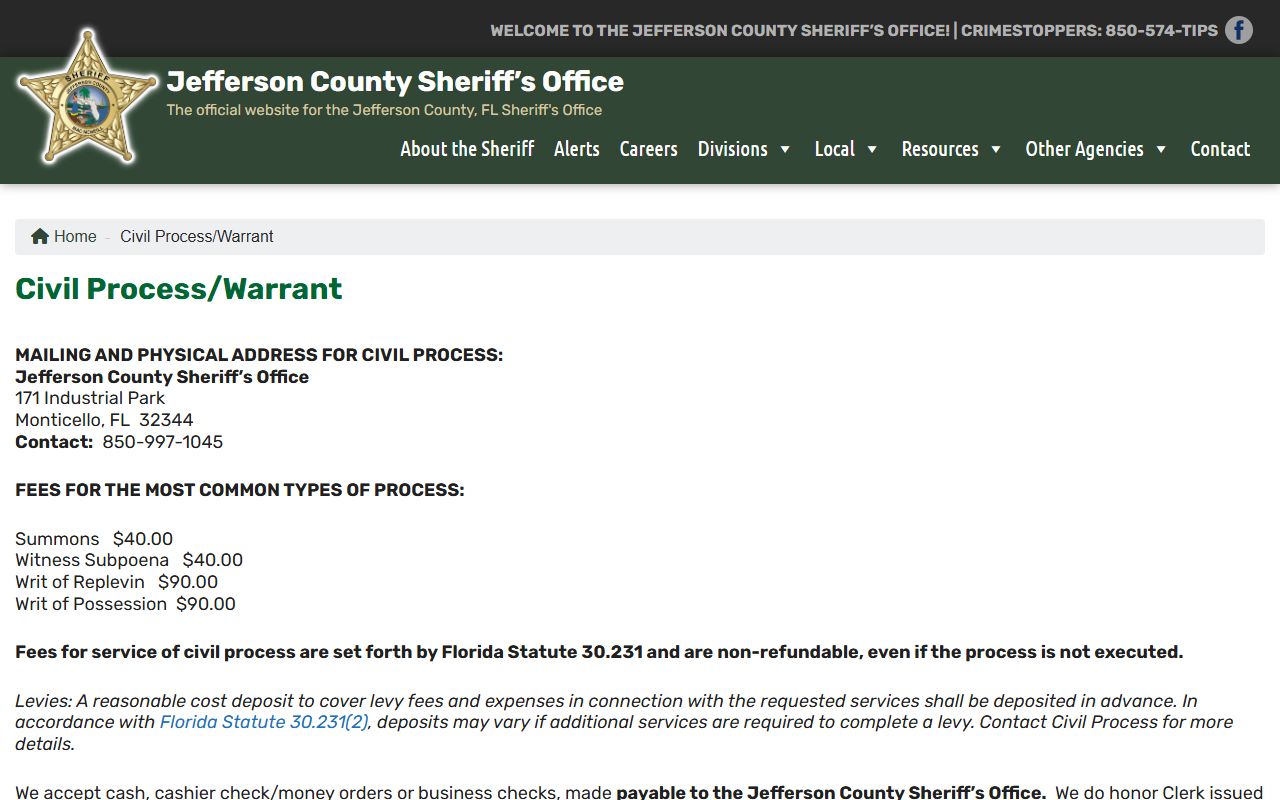
That page handles civil process fees; for a criminal warrant, the court docket and the clerk's felony department are the better local sources.
Charges vs. Convictions in Court Records
Being arrested and charged is not the same as being convicted. A charge is an accusation that opens the case. A conviction is the result of a plea or a verdict. Both can appear in court records after an arrest, but they carry very different weight.
| Charge | Conviction | |
|---|---|---|
| Stage | Accusation | Verdict or plea |
| Burden of Proof | Probable cause | Beyond a reasonable doubt |
| Public Record | Yes | Yes |
Sealed vs. Expunged Arrest Records
Florida lets some people clear a record after an eligible outcome. The clerk's felony page says sealing or expunging has strict rules, such as being charged but not convicted, the State Attorney declining to prosecute, and no prior Florida seal or expunge. Certain charges cannot be cleared regardless of the outcome. A sealed record is hidden from general public view but can be opened by limited parties. An expunged record is destroyed, with narrow exceptions held by FDLE.
| Sealed | Expunged | |
|---|---|---|
| Visibility | Hidden from the public | Destroyed and treated as if it never existed |
| Law Enforcement | Limited access remains | Very limited; held only under FDLE process |
| Eligibility | No conviction and no prior Florida seal/expunge | Stricter; some charges never qualify |
The State Attorney Who Files the Charges
Jefferson County falls in Florida's Second Judicial Circuit, where Jack Campbell is the State Attorney. The local office is at 490 West Walnut Street, Monticello, FL 32344, reachable at 850-342-0196. The State Attorney is the chief prosecuting officer for the circuit and is the office that reviews the jail paperwork and decides what charges to file. The felony division chief listed for the Jefferson office is Bert Givens.
The State Attorney's Monticello-Jefferson contact page below lists the office address and the felony, misdemeanor, juvenile, and victim-witness staff.
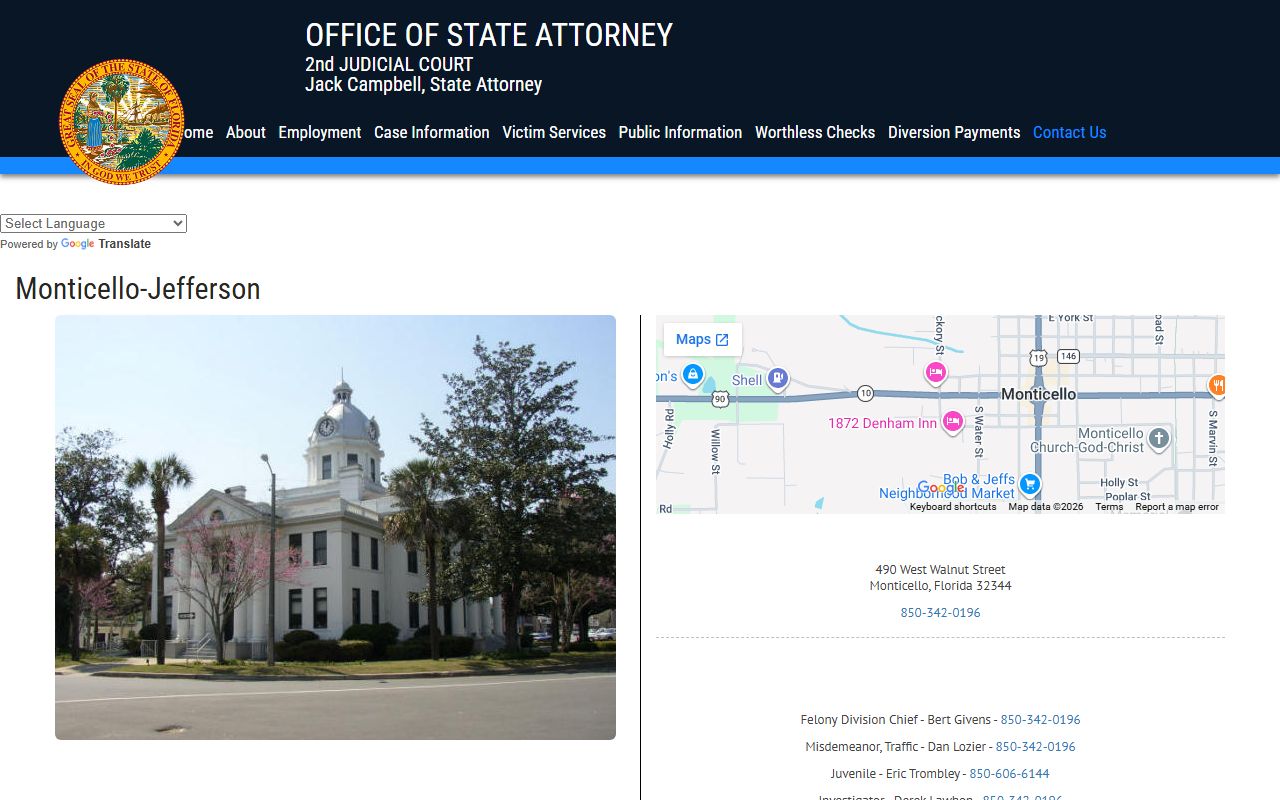
That office is the right contact for questions about why a charge was filed, reduced, or dropped after an arrest.
Court Terms After an Arrest
Court records carry terms that decide what a case status really means. These definitions help when reading a Jefferson County file.
- First appearance
- The early hearing after an arrest where a judge addresses custody and bond.
- Arraignment
- The hearing where the defendant is told the formal charges and enters a plea; a pretrial date is set then.
- Information
- The charging document a prosecutor files directly in many felony cases.
- Indictment
- A grand jury's charging document, used for certain serious felonies.
- Nolle prosequi
- A prosecutor's formal decision to drop a charge.
Background Check Considerations
Court records after an arrest are public, but using them to screen people falls under federal rules. A formal background check for employment, housing, credit, or insurance must follow the Fair Credit Reporting Act and use a licensed consumer reporting agency. A casual public records lookup is not the same thing and cannot stand in for an FCRA-compliant report.
Important: This site is not a consumer reporting agency under the FCRA, and its information may not be used for employment, housing, credit, or insurance screening.
Restricted Court Records After an Arrest in Jefferson County
Not every record reaches the public portal. Juvenile matters, sealed charges, and dismissed charges that get withheld can be limited or hidden. Most family law cases, including probate, are not posted online and must be formally requested. The clerk charges $1 per page even for a PDF, gives the first 30 minutes of deputy clerk time free, and then bills an hourly rate. Florida Statute 119.0714 governs how court files and official records are accessed and protected.